
Retaining Walls — Lake Tyler
Retaining Walls in Lake Tyler, TX
Custom-engineered retaining walls that hold back soil, prevent erosion, and transform sloped properties into usable space.
Retaining Walls in Lake Tyler: what to expect
Around Lake Tyler and the South Tyler estates, retaining walls contend with East Texas red clay over sandstone — a soil that swells and drives heavier drainage specs than the western side of our map. Waterfront walls also have to respect the City of Tyler shoreline plan where they reach the lake.
- Red-clay lots get French drain plus weep holes as standard, not an upgrade.
- Walls touching the shoreline are cleared through the City of Tyler plan.
- Segmental block and natural stone are sized to the slope and the clay's seasonal movement.
- On the rolling Hollytree and Cumberland estates we tie wall drainage into the broader site grading.
Retaining Walls on the ground in Lake Tyler
City of Tyler holds permitting and runs a shoreline-management plan with strict dock specs and prohibited-materials lists. Lake Tyler's level swings about 2 feet in a normal year, per Texas Parks and Wildlife (the TWDB had it about 2.9 feet low on November 2, 2026). Shoreline development is limited, which means every project gets scrutinized. We pre-clear designs with city staff before fabrication starts.
Recent work near: Whitehouse, Bullard, Noonday, Arp.
All Lake Tyler, TX waterfront work →Retaining Walls nearby: Whitehouse, Tyler. Who we build for here: Lakefront Homeowners, Vacation Property Owners.
What affects the price in Lake Tyler
- Wall height and total linear footage
- Material — natural stone, concrete block, or timber
- Soil type and hydrostatic pressure behind wall
- Drainage system requirements (weep holes, French drain)
- Site access and proximity to structures or utilities
Retaining Walls in Lake Tyler: questions
Full FAQ →Do retaining walls need special drainage in the Lake Tyler area?+
Yes. South Tyler estates around the lake sit on East Texas red clay over sandstone, which swells and drives heavier drainage specs than the western side of our map. We run a French drain plus weep holes as standard scope, not an upgrade — undrained hydrostatic pressure behind red clay is the failure mode we get hired to fix.
Why do retaining walls around Lake Tyler need a French drain as standard?+
South Tyler estates around the lake sit on East Texas red clay over sandstone, which swells and drives heavier drainage specs than the western side of our map. We run a French drain plus weep holes as standard scope, not an upgrade — undrained hydrostatic pressure behind red clay is the failure mode we get hired to fix. That baseline is built into every Lake Tyler-area wall.
How much does a retaining wall cost near Lake Tyler?+
A typical residential retaining wall near Lake Tyler runs about $2.7k–$7.2k depending on length, height, and material, with a French drain and weep holes included as standard scope on these red-clay sites. Taller walls and street-visible natural stone add engineering and material cost, which we scope at the estimate.
What materials do you use for retaining walls?+
We build with four families of material:
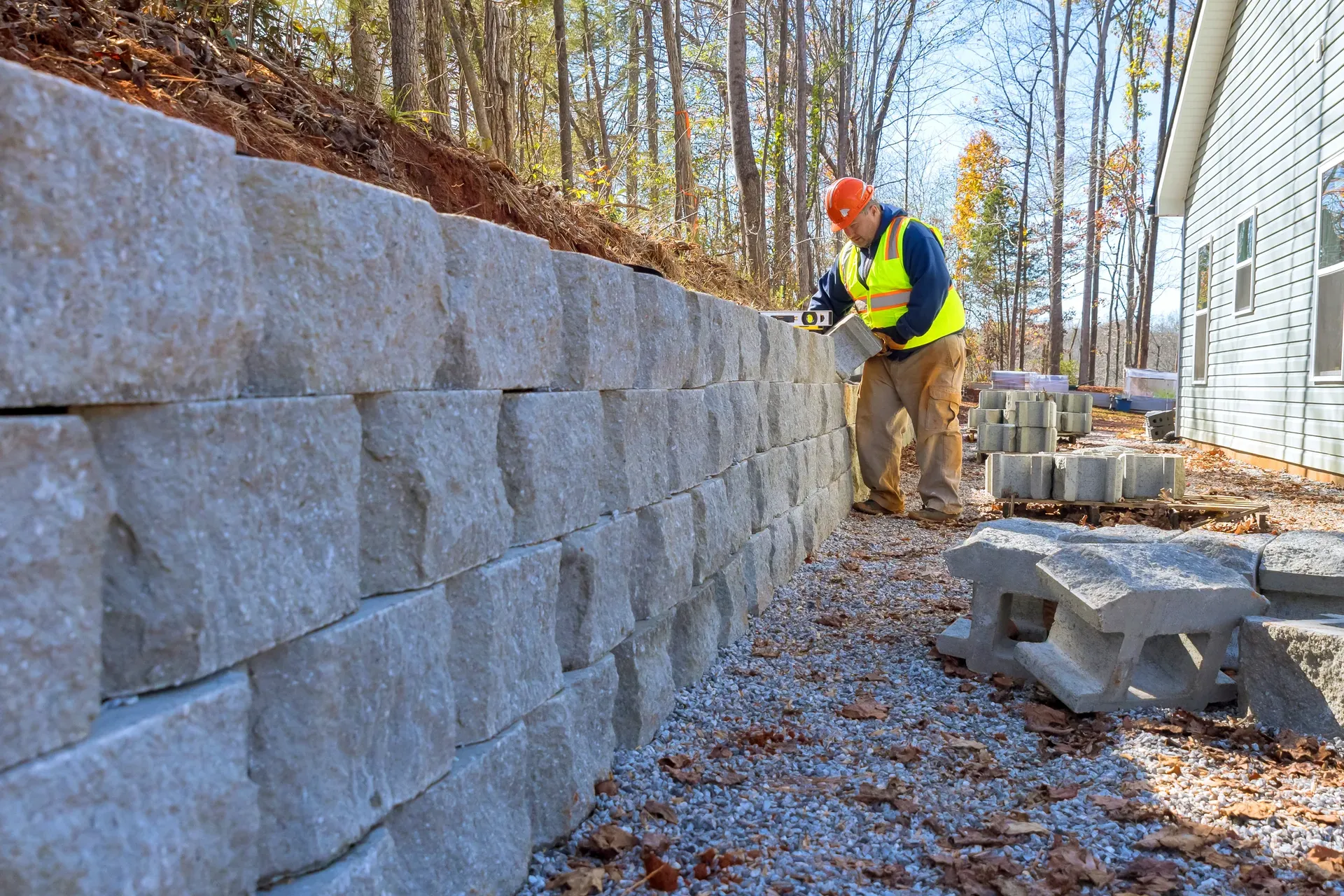
- Segmental concrete block (SRW) — the engineered workhorse, dry-stacked with geogrid reinforcement. Most common for 3–8 ft residential walls.
- Natural stone — quarried fieldstone or limestone hand-fit to a planned batter. Best aesthetic match for waterfront properties.
- Treated timber — 6×6 or 8×8 pressure-treated members for short walls under 4 ft, away from standing water.
- Poured concrete — reserved for tall walls (8 ft+) or surcharge conditions where SRW would over-engineer.
We walk you through the trade-offs in our materials comparison on this page — lifespan, maintenance, cost tier, and visual fit.
Do retaining walls need a permit?+
Generally yes once the wall passes a height threshold — most Texas counties draw the line at 4 feet of exposed face. Anything taller usually needs:
- A county building permit
- Stamped engineer's drawings (especially for surcharge from driveways, structures, or pools above the wall)
- HOA architectural review where one applies
We handle all three. If you're inside a covenant-controlled neighborhood, the HOA review is usually the slower path — boards meet monthly. Plan an extra 30–45 days for that submittal.
How long does a retaining wall last?+
A properly built concrete block or natural stone wall can last 40–50+ years. Timber walls run shorter, typically 15–25 years.
The single biggest variable is drainage. Without weep holes and a properly graded drainage layer behind the wall, hydrostatic pressure builds up after every wet season and the wall starts to bow outward. We've replaced 12-year-old walls that should have lasted 40 — every one of them had failed drainage.
Can you build a retaining wall near the water?+
Yes — but if the wall is within 5 feet of standing water, you're better off pairing it with a seawall or bulkhead toe rather than a stand-alone retaining wall.
Waterline walls fail at the toe (where water undercuts the base) more often than at the cap. A bulkhead-style sheet pile foot prevents that failure mode, and the retaining wall above sits on stable ground for its full design life.
How tall a retaining wall can you build?+
We build everything from short timber walls under 4 feet to engineered walls well past 8 feet. For 3 to 8 foot residential heights, segmental concrete block is our workhorse; once you get into 8 foot-plus or surcharge conditions from a driveway, pool, or structure above the wall, we switch to poured concrete so the design isn't over-engineered. Any wall over the local height threshold gets stamped engineer's drawings as part of the job.
Why is drainage so important behind a retaining wall?+
Drainage is the single biggest variable in how long a wall lasts. Without weep holes and a free-draining stone layer behind the wall, hydrostatic pressure builds after every wet season and the wall starts to bow outward. Every job we build includes weep holes and a French drain behind the wall, backfilled with free-draining stone before the final soil cap, because we've replaced 12-year-old walls that should have lasted 40 and every one had failed drainage.
Should I choose natural stone or concrete block?+
It comes down to look, budget, and timeline. Segmental concrete block is the fastest install for 3 to 8 foot heights, comes in a wide range of colors, and runs a mid cost tier, though it reads as engineered and can fade after 15-plus years. Natural stone is the best aesthetic match for waterfront, patinas with age instead of fading, and gives the highest property-value lift, but it's hand-fit work so it installs slowest and prices at a premium.
When does a timber wall make sense versus concrete or stone?+
Treated timber is the budget-conscious option for short walls under 4 feet on rural lots, where it's the lowest material cost and quick to install. We don't recommend it within 5 feet of standing water, because wet-dry cycling eventually rots the grade-contact members. Expect 15 to 25 years of life versus 40-plus for block and 50-plus for stone, so on a permanent feature near the house we usually steer people to block or stone.
How much maintenance does a retaining wall need?+
Less than most people expect if it's built right. Segmental block needs only an annual visual inspection of the drainage outlets. Natural stone wants the joints re-pointed every 15 to 20 years and the drains cleared annually. Timber is the highest-maintenance choice: inspect grade-contact members every 5 years and replace any failed timbers early before the failure spreads.
Guides
Retaining Walls guides for Lake Tyler
Retaining Wall vs. Seawall: Which to Choose
Retaining wall, seawall, retaining seawall — same problem, different structures. How we decide which your shoreline needs, and what each runs per foot ($150–$450 installed).
12 min readPreventing Shoreline Erosion: Homeowner Guide
Stop losing yard to the lake — here's what to install, in what order, and what it'll cost.
11 min readWhat East Texas Storms Do to Waterfront Construction
Straight-line wind, hail, and ice — the three things that take out East Texas docks and walls, and how to design against each.
11 min readFree instant estimate
See what your retaining walls in Lake Tyler could cost — in under a minute
Typical retaining walls projects run $2.7k–$7.2k. Get a tailored range for your site in seconds.
No phone call required to see your number — answer a few quick questions and the estimator does the rest.